A breeding-pile has appeared on my cabinet

I recognised the symptoms; interesting projects are being stored in all the right places, the hopper in which the ‘will-be-fixed’ items are placed has started overflowing, and along with the ‘essential-but-it-is-winter’ (so can’t be stored in the shed) the leftover bits from work exercises and the quirky-but-fun presents from family have started to accumulate on the only available spaces in my study and I think they have started to breed.

IMG_20160320_134708

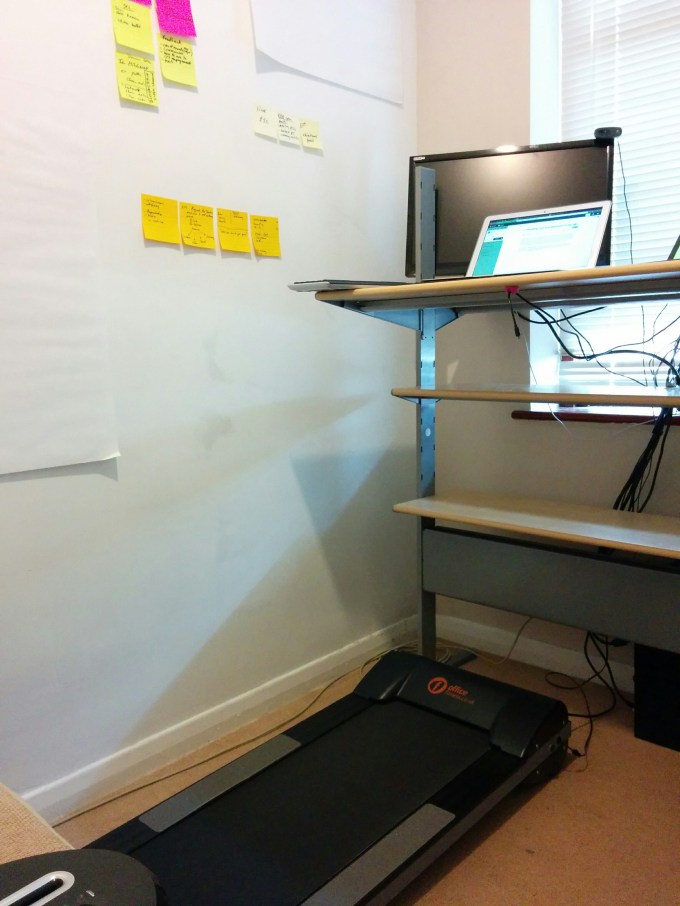
The evidence is unmistakable, even if easily refutable.  The pile has grown larger in the past year since I refurbished and painted the room in place (moving piles around from corner to corner) and since setting up the standing desk with home treadmill and whiteboard wall.  The pile is now comfortable territory and sometimes I wave and greet familiar objects jutting from its edges – projects started one weekend and then abandoned when the working week intruded, or essential fixing tools which have to be close at hand when needed, then not returned to their place in some drawer.

As Stephen Covey observed (The Seven Effective Habits of Effective People) those who get the most done, decided beforehand what to do.  They prioritise, they categorise, they get things done.  Mostly, I’d have to admit, by deciding a lot of what not to do.

So the need remains, and I have one radical solution.  Dump it all in my son’s room.  He’s away at university and I can pretend that sweeping it into there will somehow help me declutter myself over here.  Done.

I might build a smart mirror

I took a read of this and thought I could build my own smart mirror.  I have a couple of LED mirrors already which have lights either in the mirror, or underneath it.  Both have heating pads to remove misting so I guess that that will have to be removed, but otherwise it seems quite a straightforward build.

Now to source some components!

Struggling to read my weather station data

I’ve been struggling to read my weather station data on anything except the devices’ own standard displays.  For my weather station, a Maplin N96FY this means a USB A-to-A cable into the LCD display and using the excellent pywws Python code from Jim Easterbrook to load the data.  Once off the serial port on my Beaglebone Black SBC it is handled by NodeRED.

But I want to do more.  I would like to read it using a common array of antennas rather than the complex client head-ends for the weather stations and home monitoring systems.  My electricity is monitored by a CurrentCost device, the EnviR which is good but I don’t need a LCD display, so catching the C2 protocol and reading this would also be good.

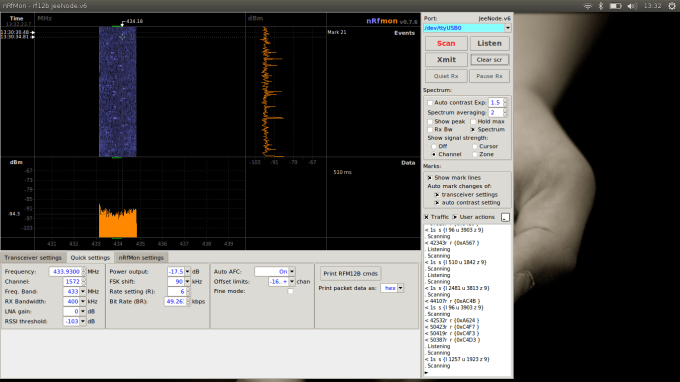
My problems have arisen because I don’t know if my weather station is OOK or FSK, and I can’t seem to read either using the JeeLink USB stick I have which has a HopeRF RFM69CW chip on them (which should be pin-compatible with a RFM12B).  But nary a poke out of them yet other than the excellent nrfmon program of which you see below.  But so far none of the FSK or OOK scanners I have used have seen any of the signals, not helped by them using the RFM12B libraries and mostly the 868MHz range instead of the 433.92MHz ISM band my weather station uses.

Fixing an F53 on a Miele washing machine

bushes.png

If you search the internet for “miele washing machine f53” you may get an answer saying that this means the speed sensor, motor, or PCB are faulty. As these together comprise almost half of the machine, you would have to dispose of it and purchase a new machine. I even found one chap unhelpfully quoting it back to a questioner and getting shown that he’d found it via Google. There may be a simple issue which doesn’t involve such drastic maintenance: if the symptoms of your “F53 Technical Error” on your Miele machine include some of the below then consider looking at the carbon brushes on the motor.

  • the machine is a number of years old
  • the F53 occurs at the point in the cycle when the drum would start to rotate
  • no maintenance has been done on the motor
  • the machine is relatively well used, say 2-3 loads per day

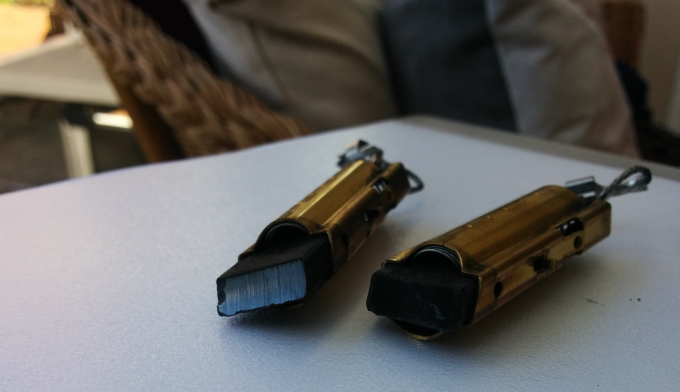
These brushes are a part that is expected to wear and when they do the motor cannot rotate the drum, which leads the speed sensor to think something is wrong and show the error. The photo attached shows the brushes from our machine and you’ll notice that one is shiny while the other is rough. The rough one wore out some time back while the other kept going, then it also reached the limit of the backing spring and could not contact the armature. No contact = no electricity = no motor movement.

We decided to take a chance and ordered replacement parts rather than the full motor, and having found a good Youtube video explaining how these were fitted we undertook the job ourselves. We didn’t even take the motor out of the body as it is accessible by removing the front panel. Once done correctly the motor whirred into life and we’re back washing. A win for DIY and a little hard work.

Doing my OOK

I’ve a Maplin N96FY, a silver weather station with an external pole-mounted wind/rain/temperature combo that measures the weather.  This is logged to Weather Underground and via some NodeRED into a Twitter account.

I’ve long wanted to removed the internal LCD display which shows the barometric pressure and external weather, and just log directly from the radio mast but it has proved difficult to understand, and Jim Easterbrook’s excellent pywws program has connected and interpreted my data for a long time.  Now, I am getting USB lockups on my connection to the head display and wanted to see if I could read the data directly.

I’ve chosen a Jeelink at 433MHz (this is the frequency which my WH1081 reports on the nameplate at the back, some others transmit at 868MHz).  I believe that the 433MHz ISM band may go away in the future, but for now that is what I have got.  The next confusion is whether the Fine Offset device transmits in On-Off-Keying ‘OOK’ or uses FSK as apparently the devices have used a variety of these over the years.

I saw nRFmon, a little arduino sketch which does a good frequency spectrum analysis and tried it out – I can see lots of activity across the 433 band as shown below.  You may see some specks of activity in the narrow waterfall display (narrowed around 434 as that seemed the most ‘interesting’ area of the graph).

Screenshot from 2016-01-31 13-32-23

I now need to identify which may be my transmitter, and more importantly if it uses OOK or FSK protocol – at the moment I’m not sure how to determine which!

Where has the hope gone?

They say that the artists reflect an era better than the historians.  At least they should say that, because I just said it.  So there.  Anyway, even if it doesn’t hold true I was musing recently about the state of Sci-Fi, a genre that I enjoy.

Take a look at some books from the 1950s and sci-fi was full of rocketships, aliens, science and mostly things that wouldn’t really work (robots that iron your clothes, anyone?).  Some things were guessed at correctly, such as satellites and mobile phones. Others were complete junk and most likely will be forever – such as pills that turn into food, warping through space, and peaceful societies.

But what fascinates me the most is how the general tone of sci-fi movies has turned from the (sometimes) hopeful futures and admiration of science into horror, alien infestations, and general unease about the advances of science.  Now, I’m no lover of scientism and think that “-isms, -anities, and -ologies” get worshiped too much rather than the actual and individual (oh Plato, put your shadows back in the cave) but the whole swing from “science will save us” through to “science infested my bowl of cereal with these GMO parasites” thing is silly.  I’ve been browsing some online services such as Wuaki, blinkbox and Netflix trying to find some sci-fi that tells a good story rather than relying on the whiz-bang effects.  Things like Cloud Atlas at least tried to do something different, although I thought the book was more explicit what was happening so ‘got it’ quicker.  But why so much darned horror sci-fi?

Well done to those directors who have taken some PK Dick themes and turned them into good scripts though.  The madness of We Can Remember It For You Wholesale would never go well in a movie, so the various efforts by Arnie and co and later directors doing the whole Total Recall movies was great – so what if it wasn’t like the book!  I guess that I like the non-messianic movies best, those that either bring an everyman into a momentous event and get them through without invoking hidden powers or other nonsense, or those that take something classic such as The Tempest and re-dress it with sci-fi bling.  I’m off to watch a Russian movie from one of the Strugatsky brother’s books and hoping someone does another good Roadside Picnic one day.  Stalker isn’t bad, just a bit old.

Doin’ my H-T-P-C

The central idea of a Home Theatre PC is to build your own box that plays movies.  Names such as XBMC, Kodi, MythTV, Windows Media Center and so on float around the blogsphere and http://linuxtv.org lists an impressive number of open source programs to do this.  The range is enormous and for each of the components you need to decide where your preferences lie along the buys versus build spectrum.  For example, there is a galaxy of cheap Android boxes which will connect to internet sources such as Netflix or Amazon and stream their content to your TV.  Heck, there are even TVs which will do that!

So why go to the effort to create your own?

Most of the people I read seemed to like the technical challenge and the openness achieved allowing them to add new services as they desired.  All that openness comes with a cost and the effort of Some Configuration Needed.  I particularly liked the components which could participate in the toolchain, so to speak, and even if they were useful as standalone services could also feed their results into other services.  So what services do you need?

Media comes from a variety of sources:

  • Physical media – DVDs and the like
  • Terrestrial digital transmission – also known as your tv antenna!
  • IPTV (stands for Internet Protocol television), which comes through the internet and can comprise
    • IPTV from the net, such as Youtube and other which are free
    • Online IPTV, such as Netflix for which you need a paid account
    • On demand IPTV that streams services to you, such as Hulu or Blinkbox or Wuaki, and for which you pay-per-movie

Each of these sources has ways of getting their content to you, and some like Netflix have their own client.  Each source will have a method to obtain that content, a way you can stage it, and perhaps a unique client that needs to be used to deliver it.  Feeds such as live TV require a TV tuner for example, while DVDs can be ‘ripped’ to home storage and later viewed. I settled onto a number of components to give me these feeds, a mixture of commercial and home-built:

  1. HDHomeRun by SiliconDust, to provide the live terrestrial digital channel tuners which could be piped around the home to mobile phones, computer screens or TVs.
  2. USB hard drive for storing movies.  I looked at Network Attached Storage devices but besides the Windows-only clients which some provide, the cost was prohibitive.  My movie collection ain’t that important!  So a 1TB USB drive attached to my home router was “good enough”.
  3. A Digital Video Recorder running on a single-board computer.  In this case I chose a Odroid C1+ and ran the VDR software on it to record live TV streams onto the network hard drive.  The Odroid is a very capable SBC and able to control a number of operations.  I used a variant of GNU/Linux and had a number of other things also running on this.  Warning: “Some Configuration Needed”!
  4. A front-end box running Kodi on a Raspberry Pi.  This was really simple to set up and everything is done using a wireless remote.  Much simpler than the Odroid PVR above, I’d rate this almost no-configuration needed.  If even this is too much, search Amazon for “android kodi tv box” and you can get some pre-setup TV boxes real cheap nowdays.

I’m still struggling on step #3, the PVR setup but other than that the whole thing just works.  I’m really pleased with what is possible with these little boxes.

AI

My avatar’s name (or ‘handle’?) is RandomAI but I’d not claim any real expertise in that area.  I did program some rule systems many years ago, including backwards chaining and forwards chaining systems, but that was as an end-user, not the people inventing it.  My handle comes from video gaming where in solitary matches often a ‘AI’ is assigned as your random opponent – hence the RandomAI name.

I’ve just read an interesting article where the complexity of understanding the human brain is described.  The writer, a guest on that blog, expresses their frustration in strong language with the grant which the EU gave “to map the human brain in a computer simulation”.  They decry the waste of money for something which has no hope of succeeding.  My only comment is that life is not logical, the world is not fair, and generally people who succeed hardly ever “deserve” to succeed.  That’s not cynical, it comes from observing corporate culture in a Dilbert-type manner.  And if you complain that things are not fair, then I’d like to ask you: compared to what?  Showmanship, self-promotion, and

The article is an excellent expose in layman’s terms to just how far away we are from even remotely comprehending how a brain works.  I especially like a comment at the end by “tdhawkes” who says they are a working neuroscientist – I’m reproducing it here in full in case it disappears from the other site.

“I am a working neuroscientist, and I support this rant. I will add this information to the rant just to boggle the mind a bit further: the response of neurons to stimulation by other neurons is operationalized by gene transcription and protein constructions in the cell nucelus that result from cell to cell signaling in each neuron’s dendritic arbor, axon trigger zone, nodes of Ranvier and terminals, and the neuron soma (cell body). This signaling happens at synapses. These transcriptions and protein constructs that result from signaling are essential for cell to cell communication at the synapse, but happen at much faster timescales than spikes, and require the maintenance and monitoring of extensive intracellular molecular signaling pathways (this is one of thousands: http://faculty.cas.usf.edu/gullah/Rsearch.html), packaging of protein constructs, and movement of such along cytoskeletal pathways to target zones at synapses, and none of these essential processes are included in any modeling of any circuit so far. Be aware that each neuron contains thousands to hundreds of thousands of synapses, and that each synapse can be composed of millions of ion channels which participate in synapse activity. Each ion channel is monitored by something in the cell — and we have zero idea how this is accomplished — because the number, activation status, and repair of EVERY ion channel is accomplished such that the synapse’s functionality in the network of synapses that affect it is optimized. So, mathbabe — do the math — billions of neurons with thousands to hundreds of thousands of synapses with millions of ion channels per synapse, all working hard to generate your experience of mind. Further, each neuron has a unique set of synapses and ion channel distributions based on the neuron’s function in the network of neurons in which it has its life. To add further complexity, it has just been shown that each neuron has unique DNA sets from which to construct proteins to operationalize the neuron’s life. And we want to reverse engineer the limited neuron behaviors we have managed to observe, and map this complex living machine such that we can imitate it with a computer whose computational mechanisms are nothing like what the ranter or I have just described. Again,, you do the math on the odds that the currents mapping methods could possibly work.”

It reminds me a little of the extreme disingenuousness of those who publish books claiming that such-and-such a gene causes this or that aspect of human behaviour and then go on to explain it with little more than hand waving.  I suspect that we’ll look back at the era of ‘gene=behaviour’ with the same horror that we reserve for phrenonlogy or eugenics.

The AI part is interesting.  I’d like to ask you: do we fly?  The answer is yes, taken as a whole mankind flies – the trillions of kilometers flown by humans in airplanes is undeniable.  Then, do we fly like birds?  No, none of us has wings, nor do we have the skeletal musculature to flap them if we did.  Yet we do fly, as do butterflies and many other things such as spiders or gliding squirrels that do not ape birds at all.  “Flying”, when defined correctly (or loosely enough) to include simply anything which purposely moves through the air from one place to another can include many, many ways of doing that.  So too, “thinking like a human brain” is so weakly defined that I imagine scenarios where almost inanimate things such as rocks could be persuaded to run some sort of mathematical simulation.

So I agree with the rant – showmanship has diverted money from boring, real science and the lauded aims of that project are rubbish – but again, who is sitting in a big office with lots of research funds and computers to play with?

When the world changes, everything does

British stamps used to have “class”.  In fact, they still do.  Trust the aristocratic system to filter down even to the philately!

The way it worked was like this: sending mail could be paid one of two ways – ‘first class’ mail was handled with priority and generally arrived the very next day, sometimes before 8am in the first delivery by the mailman.  ‘Second class’ mail would be out-sorted and travel by slower means and could take up to 3 days to arrive somewhere else in the UK – perhaps even in the second, less urgent delivery by the mailman before 11am.  People used to use this second class mail because they could send letters and cards more cheaply knowing that it would still arrive, but not as urgently as the solicitor’s letters or utility bills.

So all this worked wonders up until the arrival of the Internet, email and the general malaise in physical letter writing.  Even Christmas cards are falling in sales and people use social media to share tidings of good will to all mankind, even if they don’t know half of them.  The only things still being sent by postal mail seem to be invitations to invest in dubious foreign housing schemes or speeding bills from the local constabulary, while social media has become the vehicle of choice to speak to distant friends or relatives.

I saved money by purchasing these stamps in large quantities – as they had no face denomination you were able to use them indefinitely while the system still existed.  Over the years the colour changed, but generally the design remained the same with the image of the queen and the indicia of 1st/2nd to indicate first and second class postage paid.  I have noticed recently that my stock of stamps isn’t shrinking at any rate, certainly not an alarming one and the sole usage now seems to be sending off work receipts for scanning.  Requests from the rest of the family have dropped almost to zero and I am beginning to wonder if there is any point as between printing online postage for parcels, along with the fall in personal postage means that my store of stamps may just outlast me now…

Travel kit just got weird

I used to travel regularly and extensively, until I realised that I just got older and although it was fun, so too was sleeping in my own bed.

One of the techniques I used during that time as a “road worrier” was to keep a list to check off items so as not to forget important things.  Well it so happens that I’ve another trip in my future and decided to dust off the old list to assemble my things.  What a surprise!  Seems like digital archeology isn’t dead and the insight it gave me to previous behaviour (and technology) was insightful.  Take a look:

Shoes 1 1 1
casual Jeans a a
Casual shirt a a
Hat Opt
Shoes 1 1
Jacket a a a
Entertainment Painting Pad a a
Watercolour kit a a
Swimming trunks a a a
goggles a a a
Workshop Marker pens a a a
Camera a a a
Whiteboard Opt Opt Opt
Flip chart paper Opt Opt Opt
Laptop Laptop a a a
Product CDs Opt
Blank CDs Opt Opt
Lock a a a
Charger a a a
Battery a a a
Ethernet cord a a
Telephone cord Opt Opt a

The 3 last columns are for short, medium and long-stay trips (2-3 weeks and so on) and the increasing levels of gear meant that I could quickly take the essentials such as passport without bagging up the baggage.  Traveling light is the best way of travelling and extra stuff is the bane of comfort.  Don’t have it?  Just buy it when you’re there if really needed.

A couple of things stand out – I used to paint for relaxation sitting in some hotel rooms alone.  It was better than watching the TV or reading a book (- too heavy to take enough at the rate I read).  Nowdays, of course, I take an e-reader (not convinced about tablets yet, too heavy and batteries don’t last) but alongside the bulky camera for taking pictures of workshops and process diagrams, there were CDs and telephone cords.  Telephone cords!  Who uses those now?  Everyone uses WiFi in hotels and I haven’t seen a need for ethernet for ages.  Sounds crazy but my kit has just got whole lot lighter and between my smartphone and the Apple MacBook Air I think I can reduce my carry load of 10 years ago by 40%.

Do you have any similar stories?