Under my stairs is a cave

… full of diamonds and monsters, bats and little androgynous block figures.

The world of Minecraft is a sandbox world, with lots of running around digging and discovering all manner of ores and useful things.  My son started playing it on various servers world-wide with his friends, and eventually persuaded me to

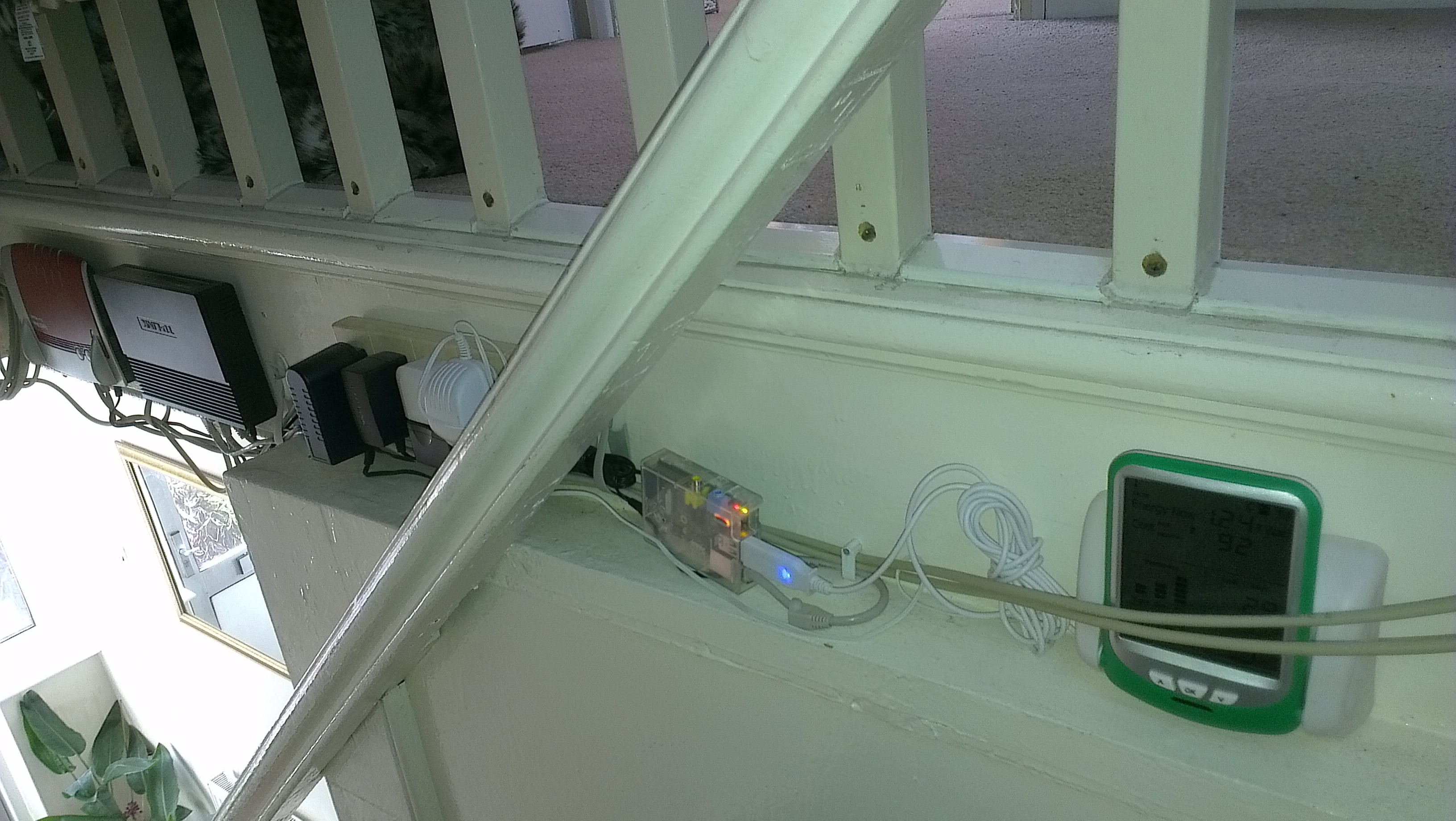
To get this running on a server under my stairs took a little bit of network and computer building, not the least of which was cobbling together a machine from bits of scrap computer parts.  It’s resulted in a multiple mess of computers, networks, VPNs (virtual private networks) and lots of computer kit wired on the side of my stairs.  Fun, fun, fun.

First off was the machine.  An old case from a friend was used with a ‘spare’ motherboard, and a dual-core CPU of which I have a few lying around.  Then the OS was loaded by putting Ubuntu onto it, and Apache loaded with the administration software called Multicraft which allows us to control it from a distance.  Then the network presented problems, so I hard-wired it into my local network to bring the total number of unique ids to approx 40 machines with independent addresses.  A little crazy but necessary for the Internet of Things (or as one friend put it, “I’ve reserved a IP6 network address for every molecule in my house”).  After a while we automated it totally so that startup would be automatic including switching on the machine, starting the OS, and starting the servers which would allow connection from my son’s gaming ‘clan’ into it.

So far they have had a ball building virtual houses and roller coasters, along with a few spats about some ‘griefing’ between players.  He connects remotely using a encrypted tunnel and I think the whole thing has taught us both a little more about computers!
Screens and dialogue

It used to be that our family would cluster around the single television screen in the house, and argue over the controls and what programme we’d next watch.  It got so bad that we instituted rules over how the selection baton would pass from family member to member.
Then all that changed.  How, I don’t know because the change was sutble and not documented.  I think along the way we gained a second television when my sister in law came to recuperate from some surgery one month, but now that screen lies dormant most days and the back screen is little used by all except for the mandatory morning chat shows seemingly aimed at stay-at-home housepersons – and it seems to assume that most of those are female.  So much for equal gender!

But something else has happened as well.  Where once the male child would have his favourite shows he now departs the house for college at some early hour, and forgoes switching it on.  The female child uses it more for dancing games on the games box we have, and most of the time I find them glued to Youtube or other internet pages.  In fact almost the entirety of what we did via the TV screen has now migrated on to the other things such as my partner watching films on a tablet in bed, while I only watch something about once per month via a streaming film service.  All in all it has moved us apart and requires that we make concious efforts to hold ‘family’ times where we talk, rather than conduct bilateral conversations that are based around barter and negotiation rather than observation and reflection.

We’ve become a family of businessmen.

Whither banks?

Are the payment processors (Visa, Paypal, payment processors) becoming the new banks?  Will they take over the traditional role which saw banks as the holders of personal wealth?

Banks arose as places of transaction where something of value could be exchanged or held to facilitate commerce.  Of late many of them seem to transmogrify into traders themselves, so witness the use of complex derivatives and speculation for its own sake rather than the more humdrum idea of transferring currency and acting for escrow.  In other words banks seem to think they are a business in their own right!  Given that much commerce is moving online, why do we need banks?  Most of my wages go directly into paying bills and daily living, very little goes into investment although the traditional banks would like you to think that’s their role.  I see a  collapse of the need for banking once a new and simple means of exchange arrives, in pretty much the same way that movie houses are being disintermediated by the arrival of self-produced and direct to consumer mechanisms such as YouTube.  While cinemas won’t disappear immediately they are far less important now than they used to be.

But with the rise (and now wane) of the internet, mobile world and especially the Internet of Things it seems that banks may be superfulous – after all most of us nowdays never enter a bank branch to transact and I’m simply astonished even when they ask you to ‘print, sign and return’ some form.

Am I about to become one of the great ‘unbanked’?  Could I ditch banking altogether and survive using Other Means of Exchange?

Searching for my lost shaker of salt

I have a fascination with note taking.
My life at the moment seems to consist of
Digital pens, while having several downsides (most of them are fat, for example – and one stressed sales person assumed I was recording one meeting where I docked my pen in its holder) do have a major advantage of being physical stuff which the customer can see, so allaying fears that you are doing your email whilst clicking away on the laptop. Tablets also have this advantage, they lay flat and everyone can see you taking notes as they talk. I’ve been in meetings where the leader has commanded everyone present to ‘close the lids of their laptops’ so as to get their attention – the fact I was merely taking notes from what he said didn’t wash.
I guess the ultimate would be some sort of unstructured, tagging concept map on a tablet which converted into structured data (with blanks) so I could export it as a presentation, spreadsheet, or document as needed. This of course brings me to think: am I creating a model for which the various instantiations are just views? Should I edit the raw data underlying the models – yet often the way that I edit needs to be through a view as well? (After all, often the order I receive data varies with the context of the meeting in which I am taking notes.)
Perhaps that for which I am looking does not exist. Perhaps I am doomed to a dismal search for the ‘perfect’ way of taking notes when all I really need to do is relax and use what information I already have. I agree a little with this since I recall when I threw away my diary I remembered appointments more accurately, not having that aid. Using the diary meant that I relied on it to remember things for me – and my memory grew correspondingly lax. I guess a similar thing occurs using sat-navs?

Old swallows new

Old swallows new. How many train trips through grey skies leaden like living at the bottom of the sea, how many business meetings with detailed agendas and suits did it take to banish the memory of gentle nights, stars like crystal in the sheer blackness of a town which still turned off its street lights at midnight? Where did all the adventures go?

Test post

Hello, I wanted to see if this ‘post by email’ feature really works???
This is just a test blog post.

I like posting by email as it works better offline and I have multiple email clients on my smartphone and desktop with which to work.

Endangered species

It occurred to me today that there is other endangered species, television EPG guides for example. When television is no longer transmitted at the broadcasters wim then we will be free to select the programs of choice at our time of choice. In addition we will most likely to select our own style of programming instead of that provided by the broadcaster.
Just as libraries provide a selection of the world’s books assembled for our browsing, broadcasters provide a selection of content for our consumption and delivery. The analogy between libraries and broadcasters is actually fairly apt since both of them have content which they provide at their own convenience for our consumption.
Instead of this in the generation of today is used to taking multiple feeds of information all at the same time. Here in the UK libraries seem to be closing at an alarming ratebut should we be worried because the contents of information is still being delivered however now it is by electronic means?  I’d not like to be a librarian though…

So what’s changing?

Today I had a delivery of a case of wine. I don’t drink much, and normally I get what bottles we do consume from the local supermarket. This time however we are preparing for an event in the future where we have to entertain a lot of people and my wife encouraged me to take a look at some of the online services.

Where does this lead us? Well for a start it seems like the delivery services are replacing the shop assistants with whom we’d interact. Most of our Christmas shopping was done online this year, and I can’t see that changing much. Our neighbours use an online grocery store while I’ve been encouraging my family to do the same. My wife instead of looking in her recipe books now looks online, while my son has read an immense number of books on his kindle.

I’ve abandoned my keyboard for this post and I’m dictating it using my android smartphone – it’s surprisingly accurate.  My use of social media has blossomed this year and it’s not just the typical Facebook post a photograph type of information.  I now tweet, google+, use Lotus Connections and LinkedIn. I noticed a distinct lack of Christmas cards this year even though I systematically sent to all my contacts. And those who still talk to me are primarily those who I contact through electronic means such as Facebook, e-mail, instant messaging and so forth.  So those who are social get more social, while those not seem to fall behind.

I think it that leaves us to rapidly and ruthlessly abandon the methods and means of yesteryear and move swiftly and ruthlessly into the new world.  Will it be pain free? Will it be seamless?  Perhaps not, but after all the new world itself changes even as we speak and the Internet is already two decades old. Where next?

Facebook keeps feeding me Australian real estate ads

Facebook may have got its tune in play; the ads on the right side of my web page in order are:

  1. how to build muscles
  2. learning to read the Bible
  3. saving water in Australia
  4. ‘best FPS game on FB’
  5. Australian real estate.

Now think about that; Facebook used to be quite crude in its advertising with want-a-girlfriend and grow-back-your-hair along with the usual furniture advertisments.  Nowdays it seems to have taken a page from Google’s playbook and has allocated advertisers into several categories which for me fall into male/christian/ex-pat aussie/video game player/ex-pat aussie!  Now while all these things are true, they are rather mixed up and unfortunately don’t represent me.  For a start there isn’t anyway possible that I can ‘save water in Australia’ since I’m a million miles away.  I don’t think there is anything which indicates that I’m a video game player so that is most likely just a promotion from the developer paying FB to carry the ad higher, and I’m a little beyond building muscles I fear and most 50yo males are more into whisky and wine than serious gym time.

I really think FB is squandering an opportunity here – they have massive data and don’t seem to know how to use it for insight themselves.  While response time is important there could be background anaytics of my data to suggest more important things including really looking at those infrequent posts and comments which I make.  For example, an important part of my family just had a wonderful little girl and I’d be more interested in baby items right now than ‘building muscles’!  Somehow, FB has choosen to make a land grab for running & ruining the internet through search, messaging, email, identity, photos and everything else they can create and is fast becoming a bloated rather than interesting competitor.  Beware the plague of creeping featureism.

Distraction time

I find that I am easily distracted.  Now maybe that is inherent in who I am, maybe it has come about because of my profession.  I started computers back when green screens were all the rage and remember encountering punched cards, algorithms, computer science and mainframes at about the same time.  Later I dealt with large-scale systems and then the micro revolution.

At the same time there is a lot of brain – speed thing in computing.  Computers do *not* work as fast as your brain and as a programmer you get used to single tasking for a while then ‘timing out’ as the computer does something.  During that time out frequently you will context switch to something else and believe me that all takes time!  Saving the stack, handling interrupts, managing the polling –> and that’s just for the hardware side, not the wetware side.  I find that PCs and distributed computing haven’t done anything to help at all – for instance I am using a wireless keyboard right now and the letter are appears with a perceptible delay as a I type.  It is really irritating and makes me distracted!

I’m also typing this while waiting for a virtual image to boot, so I can continue editing a vital work document – there, I just context switched and entered my password (which wasn’t in focus on my multi-OS desktop) – back again.  All of this training means that I find it real hard to focus on one job and take it though to completion.  Is this me, or is it my job which has degraded my ability to focus?